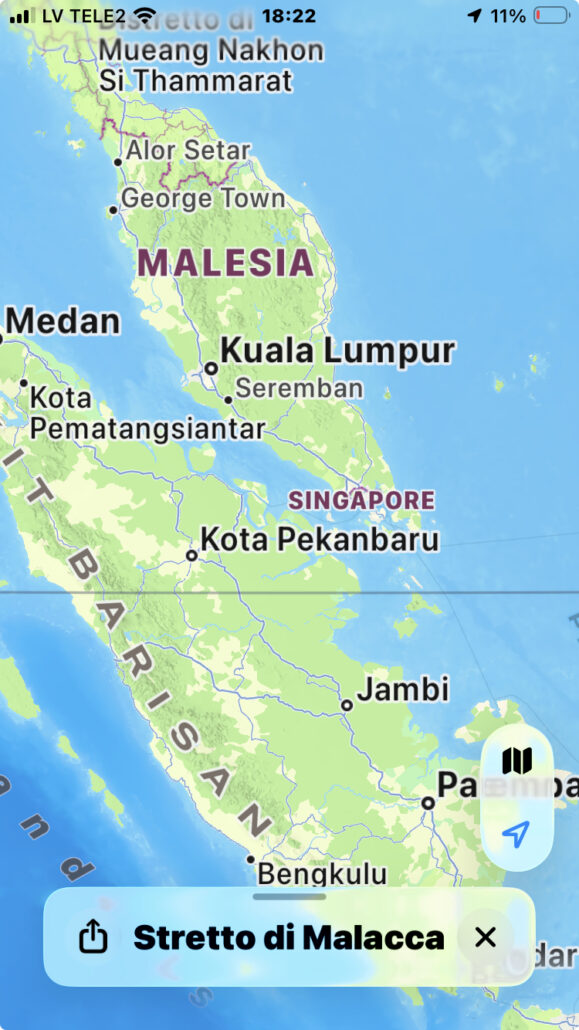
The most fascinating thing of Singapore landing by flight is the view of Malacca Strait. Port installations start twenty minutes of flying before landing. For every transteiner installed in Genoa’s ports, Singapore installed ten in its enormous harbour, starting along Malacca strait to the city. Then of course the miracle city waits you with its wonderful buildings, technology supporting everything, unbelievable clean metro, and so on until the pleasure of the big tea in Raffles hotel or of contemporary art exhibitions everywhere. But Singapore and Malacca strait are mainly the most important geopolitical chokepoint of the world. While grand territorial disputes often focus on vast landmasses or polar ice caps, some of the most critical geopolitical flashpoints on Earth span just a few miles of water. Among these, the Malacca Strait stands out as arguably the world’s most vital maritime chokepoint. Stretching between the Malay Peninsula and the Indonesian island of Sumatra, this narrow waterway connects the Indian Ocean to the Pacific, serving as the primary economic and energy lifeline of Asia.Every day, tens of millions of barrels of oil and trillions of dollars in manufactured goods pass through the Malacca Strait. It is the shortest sea route between the Middle East and major Asian economic powerhouses such as China, Japan, South Korea, and Taiwan. Approximately one-quarter of all global traded goods and a massive share of the world’s liquefied natural gas (LNG) transit this narrow corridor.
For export-driven economies, uninterrupted access to the strait is not merely a commercial convenience; it is an existential national security interest. Any disruption—whether caused by geopolitical conflict, maritime piracy, or an accidental blockage—would send immediate shockwaves through global supply chains, triggering energy shortages and economic turmoil worldwide.For Beijing, the strait represents both a vital artery and a profound vulnerability. Often referred to in Chinese strategic circles as the “Malacca Dilemma,” policymakers in Beijing are acutely aware that over 80% of China’s imported oil passes through this heavily monitored corridor.In a hypothetical conflict scenario involving the United States and its allies, hostile naval forces could easily blockade the strait, effectively cutting off China’s energy supplies and crippling its economy within weeks. This realization has driven Beijing’s aggressive push to diversify its transit routes. The China-Pakistan Economic Corridor (CPEC) and various pipelines running through Myanmar and Central Asia are direct attempts to bypass the Malacca bottleneck entirely, allowing goods and energy to reach mainland China over land.
As China seeks to project naval power beyond its near seas, the Malacca Strait has become an increasingly militarized theater. The People’s Liberation Army Navy (PLAN) routinely deploys submarines and surface combatants through the strait to secure its sea lines of communication (SLOCs) to the Middle East and Africa.At the same time, regional littoral states—primarily Malaysia, Indonesia, and Singapore—jeopardize their sovereignty to no outside power, preferring a delicate balancing act. While welcoming Chinese trade and infrastructure investments, these nations simultaneously maintain strong security ties with the United States and its regional partners, such as India and Japan, to ensure freedom of navigation and prevent any single power from dominating the waterway.The United States Navy maintains a persistent presence in the Indo-Pacific, conducting freedom of navigation operations and strengthening partnerships through frameworks like the Quad (US, Japan, India, Australia). Washington’s goal is to ensure that critical maritime commons remain open, secure, and governed by international law rather than unilateral coercion.
So when you are looking around Singapore planet attracted by this top smart city, think also to these strategic aspects of the location. Singapore was testimony of the largest British surrender to Japan in 1942 and was occupied until the atomic bombs on Hiroshima and Nagasaki. The Malacca Strait remain also today a microcosm of modern geopolitical competition. It highlights how globalization has intertwined the economic destinies of nations while simultaneously creating fragile chokepoints where economic interdependence meets military rivalry. As the Indo-Pacific remains the epicenter of twenty-first-century geopolitics, the stability of this narrow strip of water will continue to dictate the balance of global power.