When we think of South Korea, futuristic skylines and K-trains usually come to mind. But my most vivid memory is standing on a sun-drenched coastal bluff overlooking emerald-blue waters framed by dramatic cliffs and fragrant pine trees.It felt surreal—standing thousands of miles away from Europe, yet utterly transported to Southern Italy. South Korea has a quiet, rugged natural soul hidden just beyond its technological heartbeat, where volcanic islands like Jeju mirror the Mediterranean’s charm.Yet, beneath this scenic tranquility lies one of the most dynamic nations on Earth. Looking at South Korea today compared to a decade ago reveals a country radically transformed and caught in a high-stakes geopolitical dance.
A decade ago, South Korea was already an established tech powerhouse managing traditional manufacturing and watching its early cultural wave cross borders. Today, the scale of its performance has shifted dramatically: Ten years ago, South Korea’s nominal GDP hovered around $1.4 trillion. Today, it stands as a massive economic anchor of roughly $2 trillion, anchoring Asia’s major economies. Fueled by the artificial intelligence boom and high-bandwidth memory (HBM) demand, giants like Samsung and SK Hynix now command a critical share of the hardware powering the global AI revolution.
Once a regional phenomenon, South Korea is now an undisputed global cultural superpower. From Oscar-winning films to worldwide culinary trends, cultural export has become a core pillar of national economic and diplomatic leverag
Rapid demographic aging and low birth rates have put severe pressure on the domestic labor force, while household debt remains among the highest in the developed world.
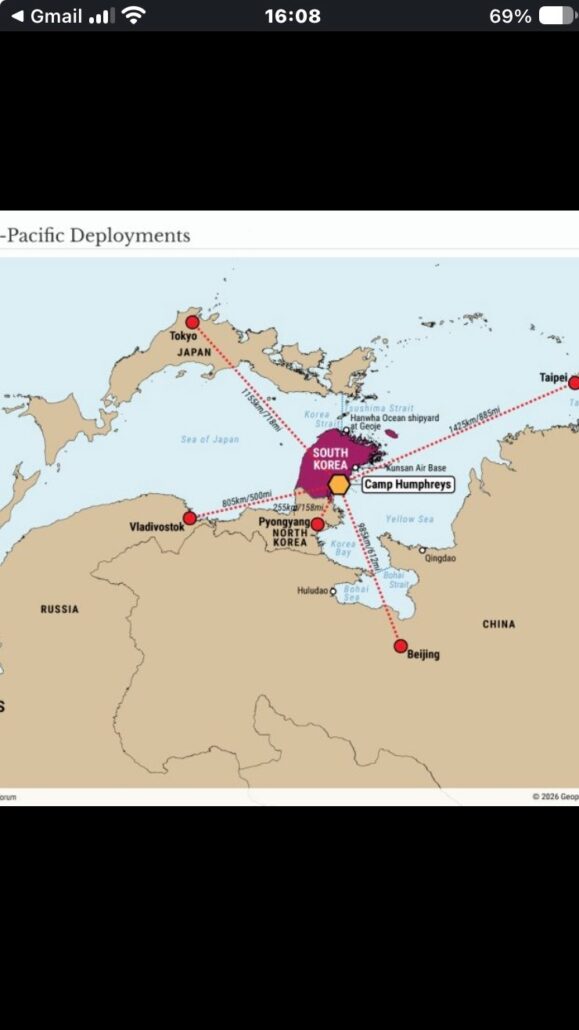
Geopolitically, South Korea sits in one of the most volatile neighborhoods on the planet. Looking at the map, it appears as a strategic anchor pinned between competing tectonic plates: Flanked by democratic allies, Seoul remains deeply tethered to Washington through a historic security umbrella, alongside recent diplomatic thaws with Tokyo. In an era of fractured supply chains, South Korea is a linchpin ally in semiconductor containment strategies. China has long been South Korea’s largest trading partner, forcing Seoul into a delicate balancing act—maintaining economic ties with Beijing while aligning with Western security frameworks. To its north sits a nuclear-armed North Korea, keeping the peninsula on high alert, while vulnerable maritime trade routes leave Seoul exposed to regional disruptions. The map shows the strategic positioning in geopolitical terms: central hub to connect Japan and Taiwan. Japan, the coloniser of both the countries, left deep heritage in Taiwan. Shorter distances with Russia and China, and direct potential conflict with Northern part of peninsula, with which no peace treaty has been signed from 1948.
South Korea’s modern geopolitical strategy is about strategic autonomy through tech supremacy. By becoming indispensable to global supply chains, Seoul leverages its economic weight to navigate great-power competition.