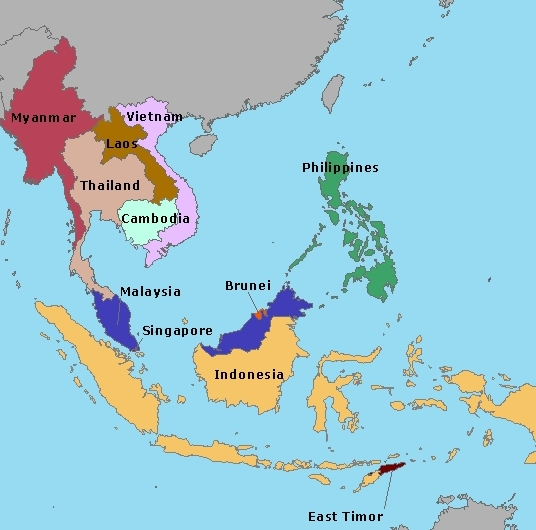
 Asia news are more and more China and India news. But one billion people live out of these giant and is the third area of enormous growth in Asia, the fourth in the world, reaching quite 4% of world GDP with 4 trillion dollars 2024. ASEAN political and economical Alliance of the region existing from quite sixty years (1967), has been successful in promoting economies, not disturbing internal affairs of countries jealous of their identity and cultures, for centuries involved in local conflicts and decolonisation process, from France and Japan. So the region crossed in the ’60ties through wars with previous and new coloniser European and USA, starting then a number of local conflicts Vietnam-Cambodia, and internal turmoil, like in Timor East, Indonesia, Philippines, Myanmar, and today again between Thailand and Cambodia (Kampuchea).The region has been occupied by Japan during second WW, on the basis of “Sphere of Asiatic Coprosperity” program of Japanese. After the defeat of France and decolonisation, China tried to become the leader of these area through direct war with Vietnam, supporting Red Khmer in Cambodia, the border guerrilla in Myanmar, but didn’t succeed really, because these populations are traditionally very suspecting of China approach, from historical experiences. Some of the nations were always independent and have a long history of fierce identity, like Thailand which was the old Siam kingdom, and Myanmar, the real Buddhist nation. Vietnam has always been in war in its long history. Indonesia had internal massacres of Chinese commercial immigrants at Suharto times. Quite all. the nations have internal islamic terrorism, especially the Catholic Philippines. The present war is an heritage of French defeat, with borders with Siam defined in nice restaurants in Paris, with no knowledge of local temples and khmer culture. Red Khmer were the most terrific communist regime at Pol Pot times, whose relishes can be visited in Phnom Pen, whereas the collateral damages of the jungle war with millions of mines can be seen in the bodies of people.
.The speedy developments of last twenty years, due to delocalisation and outsourcing processes from Europe and USA, and also from China, looking for ever lowering manpower costs have not balanced the traditional local rivalries and cultural propension to violence, masked from kind behaviour to the strangers. ASEAN remains an economic union and not a political unifying force. China can renovate appeals to peace, after unuseful trying with military and financial actions to lead the area, but USA are very strong in Philippines and Thailand, and Indonesia with 200 million people has strong ambitions of regional powership. In the meantime Bangkok continues to grow among the top cities in the world and Indonesia builds the new big capital Nusantara, which is a total smart city from the design, 1200 km north of Giakarta. The standard consumptions and welfare conditions continue to improve in the main countries, and the area wants to seat among the new multipolar world.
As historically in Europe, USA, Japan a long process of civil wars will be necessary to decide who will represent better the South-East Asia at top meeting of world governance: Indonesia seems to be the natural regional leader, but Thailand, Vietnam and Philippines will not be so open to accept Indonesian power. Main interest of China is assure an open market and peaceful conditions for its economic objectives, but geopolitical constraints are not in its favour.