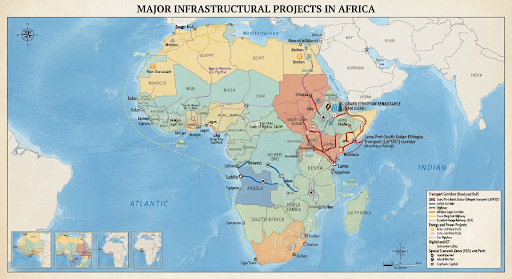
In the twenty-first century, Africa’s destiny is no longer decided solely at political negotiating tables of ex colonial powers, but along the paths of its great infrastructural backbones. Roads, transcontinental railways, energy corridors, and digital spines are no longer mere instruments of economic modernization: they are the grammar of a geopolitical redesign and repositioning. The African continent has become the epicenter of an unprecedented multipolar competition. Driven by the internal integration mandated by the African Continental Free Trade Area and the projection of external actors such as China, the European Union (via the Global Gateway plan), the United States, and Italy (through the Mattei Plan), new trans-African infrastructure is redrawing the geographies of power.Traditionally associated with paved roads and commercial ports, the concept of trans-African infrastructure has radically evolved. Today, the game is played on two interconnected fronts, physical and digital. Physical Corridors like the Lobito Corridor (connecting the cobalt and copper mines of the Democratic Republic of Congo and Zambia to the Atlantic Ocean through Angola) demonstrate how major powers compete to control the critical raw materials necessary for the global green transition. Digital sphere, as highlighted by strategic developments linked to international cooperation initiatives, is a primary infrastructure. Without reliable digital identities, interoperable payments, and widespread connectivity, economic growth risks remaining bottlenecked.
Looking at critical frontier regions—such as the Sahara-Sahel corridor or routes, like di Algerian one of 2400 km recently completed, linking North Africa to Sub-Saharan Africa—the complex and ambivalent face of major works emerges.A new highway or transnational logistics corridor does not automatically produce order and stability. In contexts marked by fragmented sovereignty or weak institution. Infrastructure reduces logistical costs and improves territorial accessibility, but this increased efficiency is often intercepted by hybrid economies, smuggling, and cross-border illicit trafficking networks. The construction of digital and energy infrastructure financed by external actors raises also crucial questions regarding the long term sovereignity of African nations. The danger is that technological and economic dependency may simply replace older forms of colonial subordination.
In this scenario, Europe is seeking to relaunch its strategic positioning. Joint actions between EU guidelines and national initiatives—such as Italy’s Mattei Plan—aim to establish a partnership built on a peer-to-peer approach, focused on:
- Elevating Africa’s role not merely as a resource reservoir, but as a hub for renewable energy and clean hydrogen.
- The realization that the construction of physical mega-projects must be paired with massive local educational and vocational training programs to ensure development is rooted in the social context.
New trans-African infrastructures are much more than a collection of engineering investments: they are the barometer of the continent’s transition toward becoming a protagonist on the global stage. The core challenge of the 21st century will not only be bridging the persistent infrastructure gap, but governing these vast networks so they become tools of genuine economic integration, institutional emancipation, and shared security, averting the risk of turning into yet another theater of neo-colonial competition.